Sing J. Lee takes on bittersweet, nuanced character studies in his debut feature film. He talks about the importance of humanization, here.
Before diving into the world of feature filmmaking, Sing J. Lee has had a hefty career directing a myriad of projects, such as Rich Brian’s The Sailor album film and Migos’ Stir Fry music video. We see glimpses into Lee’s experience through his strong use of visual language that are particularly captivating in your not-so-typical abduction film.
The Accidental Getaway Driver is a noir-esque thriller that centers around a group of four people consisting of three felons and an elderly Vietnamese cab driver, Long Mã (Hiep Tran Nghia). What Long thought was just going to be a routine late-night cab drive turns into something he least expects: an armed abduction where he unwillingly helps three escaped convicts run, or in this case drive, from the law. Based on a 2016 true story from Southern California, Sing J. Lee uses this intimate and threatening setting to capture the nuances in humanity with four unsuspecting characters.
The three fugitives kidnap and force Long to drive them around over the span of several days, in which we see every nook and cranny into the consciousnesses of the four characters in their most desperate moments. Tây (played by the iconic Dustin Nguyen) is one of the film’s two central protagonists, one who is Vietnamese and can communicate clearly with the other protagonist, Long. Here we have the personifications of two different generations of Vietnamese people in America: Long being an elderly immigrant who served in the Vietnam War and Tây being a 40 year old Vietnamese immigrant who was caught in the wrong crowd early into his life in the states. Across the 116 minute runtime, the relationship of these two characters develop in a way that bridges not only the gap of two Vietnamese generations, but also the gap of empathy between two misunderstood individuals.
Tây often finds himself holding Long captive by himself, and in these moments we get to see them both eventually show their true selves. A glimpse of Tây’s concealed loneliness spills its way out through his persistence to make conversation with Long. There’s a strong back-and-forth occurring between them both, each acting out of their own personal interests, but slowly a shift occurs where their hidden feelings and intentions rise to the surface. Two people that could not have been any more different find out that they have more in common than one might think; they seek companionship.
We can’t forget the other two fugitives, Eddie (Phi Vu) and Aden (Dali Benssalah), who have equally important roles in deconstructing the ideology of a singularly faceted person. Eddie plays the 20 year old Vietnamese kid that doesn’t know any better; he represents another generation of the Vietnamese-American. Aden is the one of the only non-Vietnamese characters in the film and he plays the antagonist and antithesis of Long; all he knows is the life of crime. The plot and characters have all you need for your average Hollywood action-thriller, but Lee instead transforms this Orange County news story into an in-depth dissection on the multifaceted identities of humans.

I had the chance to meet Sing this November, when he screened his award-winning debut feature at the San Diego Asian Film Festival, the largest presentation of Asian cinema in North America. In my interview with him, he talks about the importance of empathy in storytelling, the politics of art itself, and how we are all connected through everyday lived human experiences. Here are some edited excerpts from our conversation.
What does it mean to you that your movie was screened at the San Diego Asian Film Festival?
Within the selection of films [at the festival], it’s been exciting for me to see the names of auteurs — both the next generation and the ones who have pioneered the generations of Asian cinema — share this space together. There’s an extensive knowledge, sensibility and understanding reflected in that programming, so to be a part of that, that’s an honor in itself. This year, Ann Hui was a part of it. She’s a filmmaker that I truly admire and has been influential for me, not only because she’s a Hong Kong filmmaker too, but also because I found myself revisiting her Vietnam trilogy during my filmmaking process. I found a real personal connection to the programming that doesn’t just pertain to the film itself.
There’s definitely a large difference between Asian cinema in the East and the West. In your movie, I see both aspects quite clearly. Would you say that’s a combination of what you studied as a director or is that something that came to you naturally?
I think it starts first with what cinema means to an individual. Stories in general are there to entertain us, but they’re also a window to a personal perspective that you may not have encountered, but can draw bridges from your own experience into the story. To that end, cinema to me isn’t just a form of entertainment but it is an extension of a life experience, a mirror to what you’ve experienced as a person. As somebody who was in Hong Kong but was born in the U.K, has had experiences in Europe and experiences in America; you’re obviously shaped by a multitude of cultures. I don’t think it’s so much even as a conscious decision, it’s just an extension of how someone tells a story. These characters [in the film] are a spectrum of the idea of assimilation or duality, the failings of doing so, the costs and compromises of what that means, but that extends into the language of cinema itself.
This idea of storytelling and identity go hand-in-hand. With the movie being heavily predicated on the Vietnamese identity, how did you take that into account when you were directing?
I think it starts, again, with empathy. Empathy into the human spirit, the human condition and into lives, which couldn’t be more pertinent, especially right now with everything that we’re all experiencing and witnessing. It’s important to understand the historical and cultural context of these characters, and from there you understand that you don’t have to be intrinsically of that culture to understand the emotions and experiences that these characters are feeling and going through. By that virtue,when you break it all the way down, everybody can share in these emotions. Everybody feels the same elation and fear and joy and concern and love.
Given that the film is predominantly in the Vietnamese language, did you face any struggles when trying to direct in a different language?
It starts almost conceptual with the shared experience or the shared observations within one’s own culture to another that there is the importance within language, within generational language. If you can understand that, it’s a good starting point. I’ve seen it in my family across different generations. The way of speaking, whether it’s dialect or whether it’s generational, there’s a time capsule to each and that obviously plays between the three characters. To be empathetic of that, it can lead to great conversations with a strong team who all contribute to the translation of the script and the dialogue.
There was one moment in the film that really stuck with me. There’s a nuanced, Vietnamese pronoun switch in Tây and Long’s conversations, going from formal to familial. Was this originally intentional or was this the work of your translator, Ly?
So that would come from conversations – and it’s a really good question – because that, in a way, is reflective of how deep the conversations were with Ly in terms of what they would say. I think it’s really interesting because it’s so important to talk about and at the same time, it’s sad that we’re talking about this. The idea that characters don’t speak in a way that is truthful to a community shouldn’t be such a revolutionary notion. However though, everything we’re talking about – the intention to make a film that represents the Vietnamese-American experience and the diaspora – has to come from a place that isn’t from the Western gaze of introducing an audience to characters with no exposition on the meaning of language.
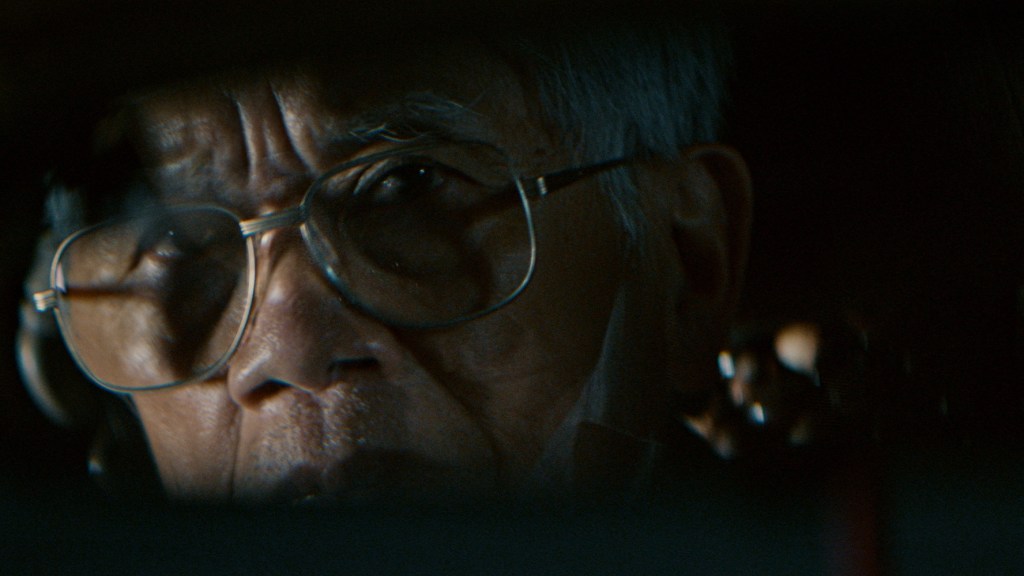
There’s a lot of close-ups on Long’s face and you see looks of panic, anxiety, and even suffocation and claustrophobia; scenes that make the viewer uncomfortable at times. When you first read the real story, did these ideas come to you naturally or did they come as you were writing?
Visual language is as important to film as character and dialogue themselves. But I think they only work when there’s a motivation. I’ve always been someone who is partial to the idea of how visually striking close-ups can be in storytelling. Long is restricted by not understanding half of what’s happening in the room by language, and he’s also incapacitated. So through that, we see the way that Long might see the world, and that is through these details which are inescapable. They serve storytelling functionality and motivation to Long’s character, but then also it’s visually compelling to make the audience feel the claustrophobia that these characters are feeling.
You briefly mentioned it earlier: there’s the Palestinian genocide going on today. There’s so many stories of humanity to be told there. How does this correlate to you as an artist, bringing together art and politics?
It reminds me of something even earlier this week that I saw. It was accredited to Ai Weiwei, but I’m sure it’s a statement that has transcended just Ai Weiwei. The ideology to separate art from politics itself is a political action. If you feel compelled to tell a story based on an experience that someone has had and you relate to, then that itself is the experience of being human. It leads to discovery and empathy, which leads to something more productive; understanding each other beyond divisive social constructs. That’s why the function of art is very important in this time, because art can be more truthful to the human spirit. It’s always important to humanize the world that you see around you, because if not, you’re in danger of oversimplifying an individual to the broad strokes of propaganda, dehumanization and misinformation. That’s the power of art and storytelling and why it is still important in the most trying of times.
Was the idea of humanity something you’ve always been passionate about?
It’s something I’ve always been drawn to. That comes from personal experience too, as someone growing up as different to the society I grew up in. That in and of itself is such a universal feeling that goes beyond the social constructs of race and culture: otherness. When I was younger, I felt anchorless to a culture. I felt like an outsider to the environment I grew up in. It’s such a terrible notion to be anchorless but as I got older, I found the other side of it, which is perspective and shifting perspectives. That pursuit of always trying to fit in and trying to understand your place becomes something that inherently leads to all the themes we’ve been talking about and I personally find that exciting within telling a story.
Where do you see yourself going forward from here? Is there anything you want to pursue specifically?
For the foreseeable future of the next series of films that I would hope to make would in some way be reflective always of the human condition or the human spirit, transcendent of any particular culture. We also can’t forget the power of entertaining in stories, and by doing so, you get to explore characters in genres that can be more colorful and more memorable and more vivid, and hopefully give you another window into a world you’re unfamiliar with. I want to do this in as truthful a way as possible about people. I think that would be the intention, whether that is in film or television.
 mattkore