Kiyoshi Kurosawa presents an updated critique on the digital age in this action-thriller
With tinges of Pulse, Serpent’s Path, and even Charisma, the Japanese horror auteur Kiyoshi Kurosawa directs his latest action-packed crime thriller, Cloud — it’s safe to say that he’s back and better than ever. Following the success of Chime and the French remake of Serpent’s Path, Cloud cements one hell of a year for the veteran director, and his busy schedule didn’t come with any sacrificial quality; these are his best works of the past decade. What starts off as a slow-burn character study of modern capitalistic effects on the average laborer eventually evolves into an intense shootout, a critique of both the attached and detached nature of the digital world.
Kiyoshi Kurosawa’s films are known to challenge and assess human existence, bringing an existentialist nature to rather mundane and simple topics — think of the family-horror Tokyo Sonata. Cloud plays perfectly into that signature style for the most part; the first half is a slow build-up that eventually implodes upon itself to reveal a psychological monstrosity seeping into its midst, riddled with some of the best action sequences in his career.
Revolved around the average factory laborer, the banal Yoshii Ryosuke (Japanese star Masaki Suda) cares little to nothing about his job, as shown by his apathetic behavior when his boss offers him an unwanted promotion. The thought alone prompts him to quit his job and pursue a reselling business with inspiration from an old acquaintance, Muraoka (Masataka Kubota); he sells whatever to whoever (most of his goods seem to be counterfeit), with only the screen’s notification of “Sold” driving himself to continue this soul-sucking occupation. As he conducts his shady business, the shady business also finds him in the form of doxxers, Yoshii’s reselling victims attempting to enact revenge on him through little means of harassment.
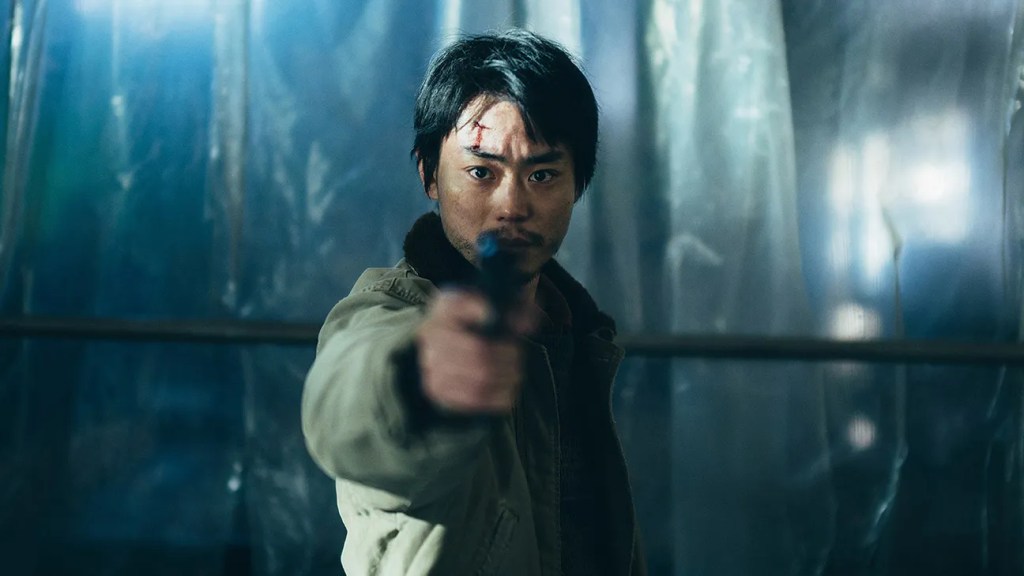
With his unassuming girlfriend Akiko (Kotone Furukawa), he packs up his stuff and moves into a rather spacious lakeside house outside of Tokyo, where he doubles down on his reselling venture. After hiring a “talentless and unskilled” local, Sano (Daiken Okudaira), business slows down, with most of the products collecting dust on the shelves and the police inquisitive about the authenticity of his goods. Not only is his work life in disarray, but his harassers in Tokyo have seemed to follow him too, as a car motor is thrown through his bedroom window, terrifying his wife and giving her a reason to want to move back to Tokyo. No matter how much he tries to take control of the tumbling situation, things only manage to get worse and worse. A group of Yoshii’s victims band together with the help of an internet forum; they plot to play a “game” and punish him in their own sadistic manner. The rest of the film follows Yoshii attempting to escape from his victims as they plan to torture and eventually kill him, where he asks the most important question that drives the premise at heart: “Am I… so bad?”
Working as a major critique of labor concerning capitalism as the digital age has fully commenced, he takes the central idea of Pulse and updates it to the modern era, a time where the use of the internet has become more sinister, more predatory, and more detached than ever. The character of Yoshii embodies the moral question posed earlier; he simply wants to escape the life of a laborer and make money on his own terms. The question isn’t meant to be all that simple — of course, what Yoshii is doing is wrong — however, the factors that drive him to begin reselling and the over-accessibility of the internet become a more layered topic of discussion that begins with a conversation about the ownership of labor. The system in place allows for — and even encourages — such behavior, yet acts surprised when deadly consequences take place on either side.
The final third of the film views in a way that looks more John Woo than Kiyoshi Kurosawa, but his ideas presented reflect a more serious nature than the film’s surface might seem to convey. Through the clash between Yoshii’s former employer and new employee and by bridging the gap between the digital world and reality, he weaves in quite an amusing and unique critique using a play on labor roles and the false sense of anonymity of hiding behind a computer screen. Both serious by nature and unserious by portrayal, Kurosawa doesn’t stray from his conventional style, instead using it to mirror the almost silly subject matter at hand. It’s his most straightforward project yet but it works, as the psychological horror that has haunted him for the last two decades are becoming more and more physical.
 mattkore