Wim Wenders’ road movie classic is a bittersweet, perpetual odyssey
I often romanticize the dense, almost claustrophobic, cityscapes of New York, Tokyo, or Seoul, dreaming of being packed into subways with thousands of other people I’ll never see again; rinse and repeat day after day. I’m sure many others share the same sentiment, being able to hop on a train and wander around for hours, allowing yourself to feel lost in a city that you should know like the back of your hand. Wim Wenders shares a similar sentiment, although shed in a different light, as the state of always moving and remaining adrift is core to Paris, Texas (and many of his other films), playing hand-in-hand with his fascination of the vast American landscape; it is a ballad to both the expansive environment and its subjects.
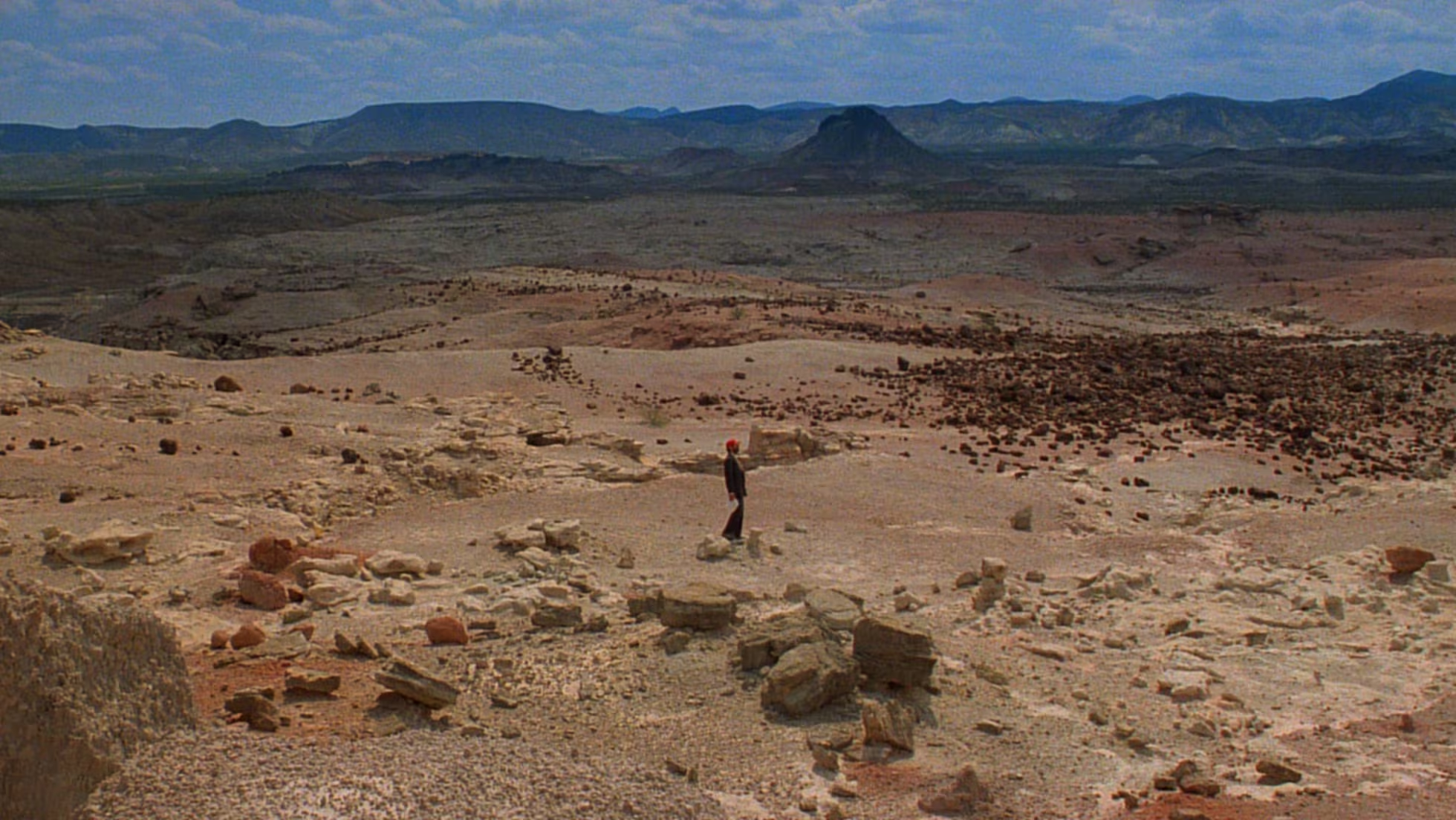
Harry Dean Stanton plays Travis, a man wandering through the Texas desert with no destination in sight, simply a minute figure amid rock formations and canyons. He’s been off the radar for four years until his brother finds and reconnects him to his eight-year-old son, Hunter. Travis slowly develops a new relationship with himself, Hunter, and Jane — his missing wife that he spends the latter third of the film searching for — in which he invariably leaves them all again to go back to the great Texas desert. But of course, although the film’s synopsis can easily be strung into a few digestible sentences, the substance at hand is far greater than the simplicity of its plot, told through the varying beauty of the American scenery.
The film begins and ends (through implication) in the desert. Wandering lost through a desert is neither inherently good or bad, solely dependent on whether this state of being lost is intentional, and for Travis, the desert is the most ideal place to be. What makes the setting such a striking image is not only how large it looks around him, but it’s moreso how endless it can seem. It’s almost an extension of Travis himself, as if he were to cast himself unto the earth and travel the terrain of his own melancholy, finding there to be nothing but the ground beneath his feet. It’s only until the end of the film when we fully understand the extent of his regret and emptiness, and it’s at that same time he returns to where he once came, as if choosing to be lost forever is less of a burden than dealing with the turmoil of being.
Driving and walking are the preferential modes of travel taken, modes in which Travis has partial control over his destination; at most instances he can choose to venture off the beaten path. Though a lot of movement takes place on the screen — as is typical of road movies — it’s unsure of whether there’s any advancement within Travis’ personal journey. And if there is, it ends up quite circular anyways. There’s a certain mindlessness that exists when driving on an empty road or highway, whether there is a destination in mind or not doesn’t particularly matter as your autopilot will kick in before you even know it — Travis exists within that space in between the origin and destination. At the end of the film, he reunites his estranged wife and their son, only to leave behind everything that he had rebuilt and move on from a life that could have potentially been his again. Wenders implements a beautifully ambiguous ending to the film (and such, Travis’ journey) yet it only feels right to think that Travis returns to the vast landscape of the desert, and in turn, to himself. The signature score of Ry Cooder makes a return in the final seconds of the film to cement that idea, hypnotizing both Travis and audience, so as to say: maybe it’s okay to keep moving.
 mattkore