Tsai Ming-liang’s spiritual masterpiece reflects on immortalization as love and grief
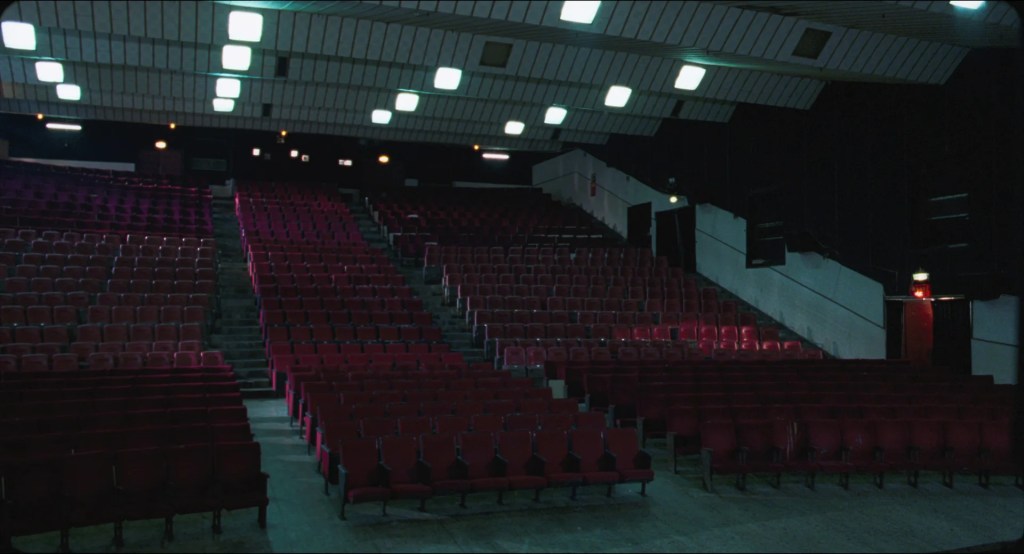
Shared, communal spaces, in this case the movie theater, are sacred in a world that can seem so isolated at times, generations of people have sat in the same seats to share the same experience: the joy of watching films. Tsai Ming-liang’s Goodbye, Dragon Inn touches on the heavy spirituality and immortalization that exists within the ever so sacred cinema, a shared space that has been suffering a long, torturous death beginning not so long after its inception. His film, however, is not one solely of grief, rather it is one of love and remembrance, an ode to movies — and in turn movie-going — that echoes across generations intertwining the past into the present.
The film starts by showing the Fuho Grand Theater packed to the brim, screening the King Hu classic Dragon Inn, a film that Tsai himself believes represents the Taiwanese Golden Age of Cinema. It quickly cuts to a relatively empty theater, with a few half-amused theater-goers here and there, screening the same wuxian epic during its final day of business. Although there are no protagonists of the film — there isn’t even a plot — each character is equally important in portraying the decay of the cinema and at the same time, its lasting impact. Through the long, static takes of the tourist comically interacting with fellow movie patrons, the receptionist wandering around aimlessly looking for things to do, or the projectionist manning the entire operation, there’s a strong sense of intimacy within the characters and each other, and to their surroundings.
Tsai juxtaposes the long static takes with ephemeral instances that highlight how short-lived our moments with strangers really are, even if the uncomfortability make them feel as if they last lifetimes. The tourist moves from seat to seat after each patron that he sits next to ultimately drives him away with their antics, whether it’s chewing too loudly or propping their bare feet right next to his face. As he leaves the screening area and wanders around the rest of the cinema, he finds himself in similarly awkward situations: he becomes sandwiched in a urinal, a man gets uncomfortably close when scooching by him, and lastly he is told that the cinema is haunted. Though they work strongly as comedic effect (Tsai tends to invoke humor into even the most serious of his works), they also emphasize the significance of communal interaction. Of course the idea is rather exaggerated, Tsai isn’t saying that any of these movie-going situations are ideal, rather they remind us of this concept of shared experiences and intimacy, one that will eventually cease to exist in the age of “on demand.”
Two of the viewers of the final screening of Dragon Inn are Miao Tian and Shih Chun, watching a younger, immortalized version of themselves on the screen, hacking it out in pure wuxian fashion. They sit only a few rows apart and turn to each other with a rather solemn look in their eyes; Miao Tian even sheds a few tears watching himself for what seems like one last time. They meet together in the lobby after the screening and exchange a few words in one of the only instances of dialogue in the entire film: “No one comes to the movies anymore.” Perhaps the strongest statement — and the most direct — is made here. Using the original actors of Dragon Inn only bolsters the prevalent spiritual and sentimental nature of the film; a barrier of physicality lifts and the work transforms into something more metaphysical and metatextual. It becomes more than just a love letter to cinema, it’s a display of extreme reverence towards those who have transformed the medium. Miao Tian and Shih Chun will forever exist, as will Dragon Inn, as will the Fuho Grand Theater.
If there was to be a protagonist of the film, it would be the Fuho Grand Theater itself, as an entire story could be told through its water-damaged walls, leaking ceilings, and ghostly liminal spaces. Characters meander through its narrow and empty spaces, as if one with the building itself. The lights are dim, barely functioning, casting a spectral ambience to the already otherworldly atmosphere. The heavy rain patters down, staining the walls, permeating the ceiling, washing away generations of life, welcoming the next era to come. Liminal spaces are always a treat to behold; they transpose the spiritual world into reality, transcending the experiences of the movie-goers into something more meaningful and consequential than simply attending a screening. It’d be a shame not to mention the great Thai auteur Apichatpong Weeresethakul in this topic of spirituality and slow cinema, for his work rather epitomizes the nature of the subject. He once said, “entering a movie theater is not unlike entering a dream,” and for both the patrons within the film and the viewers (us) of the film itself, it can be hard discerning dream from reality. Tsai Ming-liang has stated that the realism in his films isn’t realism in the natural sense, rather it is closer to dreams. Memories and dreams are so similar in the fact that they are ever fading and only exist in solitary states within our minds, permeating the consciousness in means that nothing else could; Goodbye, Dragon Inn entrances the viewers in that same fashion.
Damien Chazelle’s Babylon similarly is both a love letter and critique to the industry — although it does focus more on movie-making rather than movie-going — showing that the medium has been on its road to demise very quickly after its rise. It puts on a glorious display of the mountainous highs and the desperate lows of Hollywood, however unlike Goodbye, Dragon Inn, it ends the film with a packed, joyous theater rather than an empty, desolate one. Towards the very end of the film, we sit in silence for minutes of a static, empty Fuho Grand Theater, soaking in both its life and its death, feeling the weight of its history and its impact. It’s hard to interpret whether or not theater-going, and in turn the medium itself, will survive another 25 or 50 years. Now with the introduction of AI in filmmaking, Hollywood producing slop at increasingly higher rates, and theater distribution decreasing to make way for ‘direct-to-streaming’ business plans, there seems to be no hope for the future of film as a communal artistic experience. Goodbye, Dragon Inn only becomes ever so important 20 years later, so that these spiritual experiences can never be forgotten and forever ingrain themselves into the history of cinema – to grieve and to remember, with this it can never die.
 mattkore